
BaseFortify Features
See how BaseFortify maps your systems to relevant vulnerabilities, helps prioritize risk, and supports remediation from one practical workflow.
Clear, Focused Vulnerability Insights
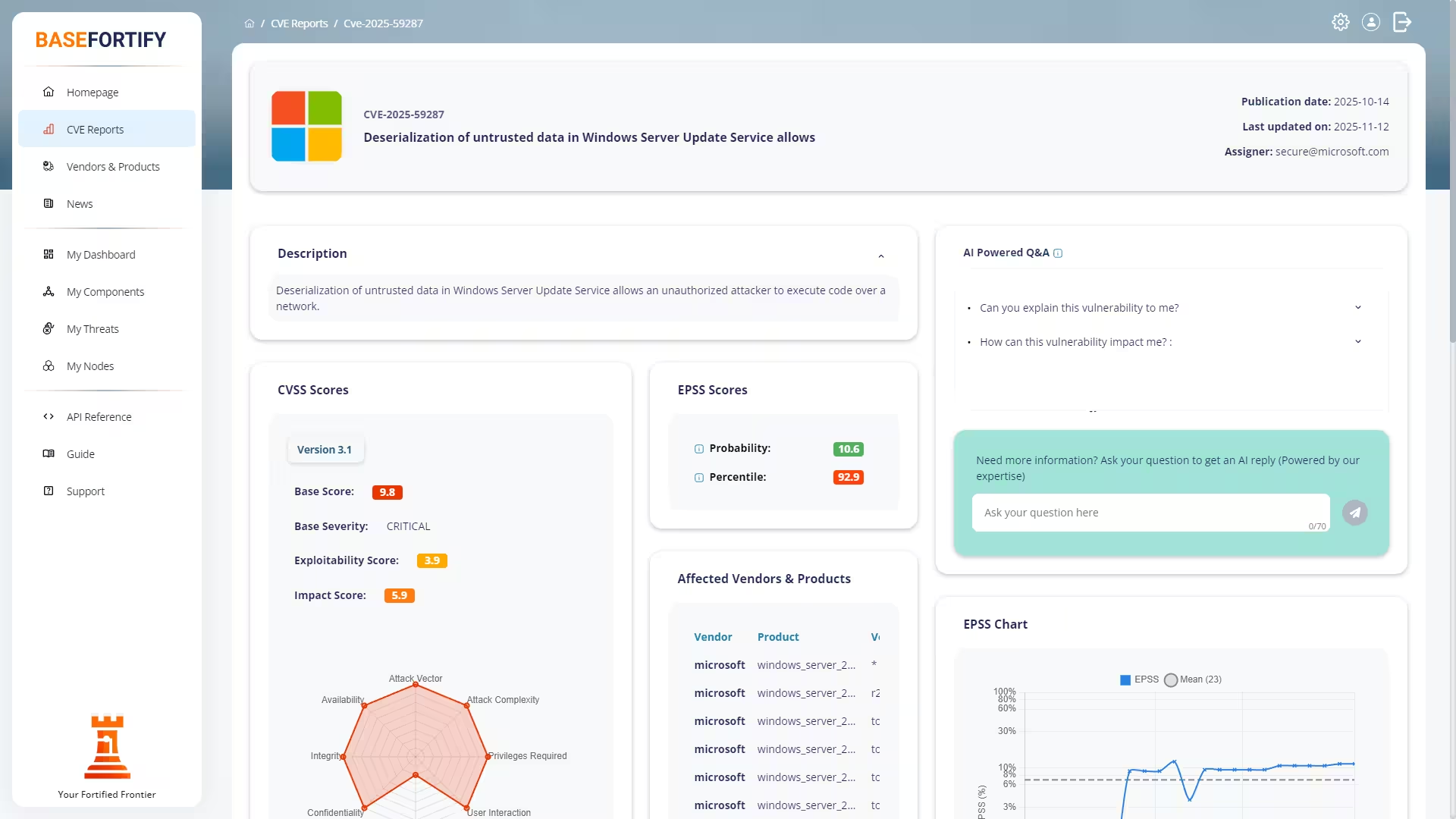
Stay ahead of emerging risks with clear, prioritised vulnerability intelligence. BaseFortify enriches CVE reports with severity scores, exploit probability, known exploitation status, and trusted security references. Understand which vulnerabilities deserve attention, why they matter, and what actions you can take. Clear explanations and practical remediation guidance help you make informed security decisions.
Built for Every Environment
Track vulnerabilities across Windows, Linux, macOS, and virtualised environments without installing agents or deploying intrusive scanners. Add your software and operating system components manually, import inventories, or synchronise them through the REST API. Whether you manage a small office network or a distributed environment, BaseFortify helps you identify relevant vulnerabilities and maintain visibility across your systems.
Threat Intelligence Made Practical
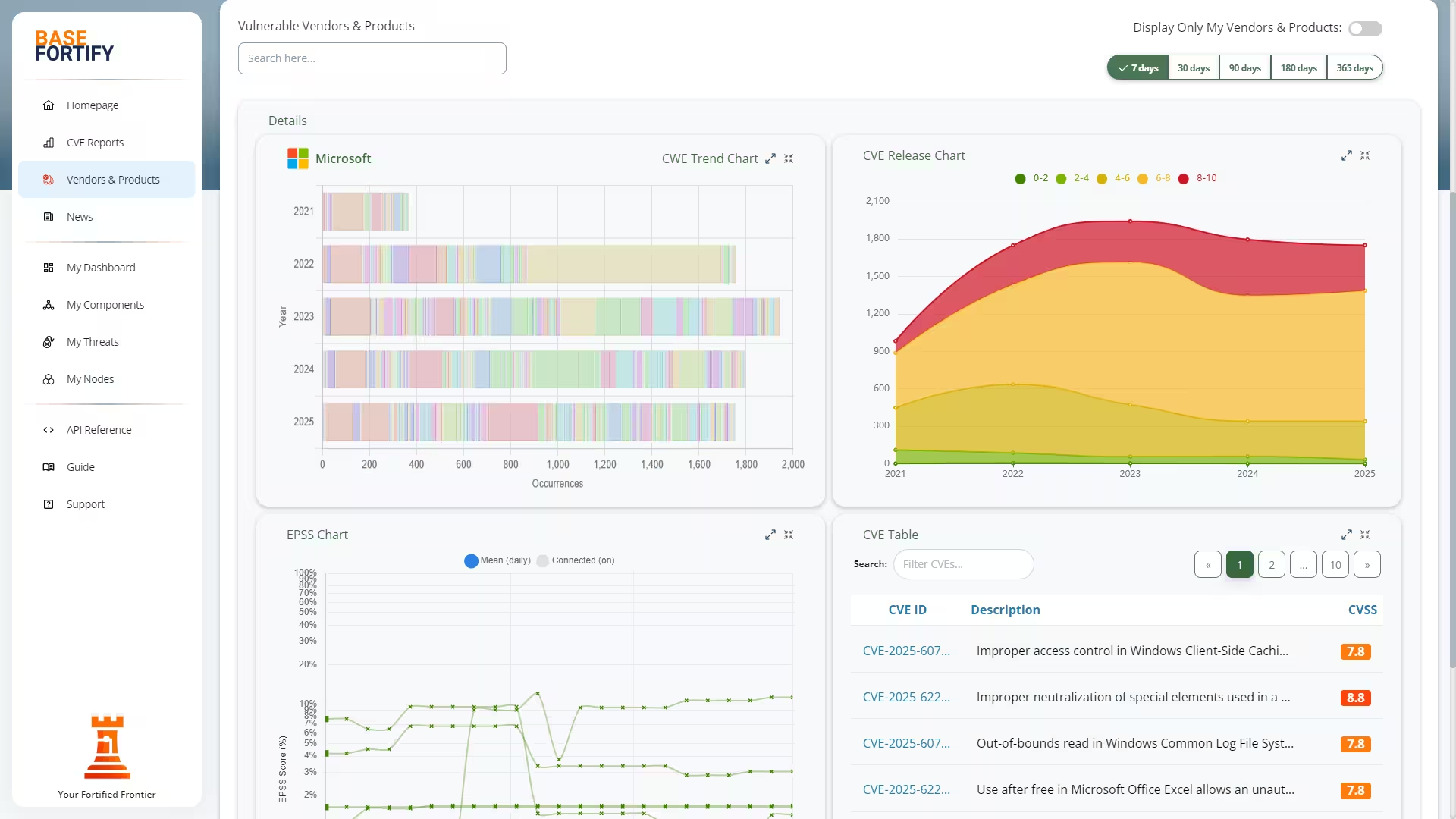
Turn vulnerability intelligence into practical security decisions. BaseFortify combines CVSS severity, EPSS exploit probability, CISA KEV status, and CWE classifications to help you understand and prioritise emerging threats. With Security Radar, you can also follow cybersecurity news, newly disclosed vulnerabilities, and security developments from selected sources. Together, these capabilities provide a broader view of the threats that matter.
Key Features
Powered by trusted sources: MITRE CVE/CWE, FIRST EPSS, CISA KEV — with AI assistance to keep it simple.
Cross-Platform Vulnerability Coverage
- Match your applications, operating systems, and services against known CVEs — no complex scanning or intrusive deployment required.
- Track vulnerabilities consistently across physical, virtualised, cloud-hosted, and mobile environments.
- Supports vulnerability tracking for Windows, Linux, macOS, and other recognised software platforms, including applications and services.
Vulnerability Prioritization
- Prioritise vulnerabilities quickly with CVSS severity and EPSS likelihood to see what needs attention first.
- Identify high-risk issues with CISA KEV to understand which vulnerabilities are actively exploited in the wild.
- Focus remediation effort on the items that matter most instead of getting lost in long CVE lists.
Enriched CVE Reports
- Explore detailed CVE reports enriched with official references, vendor advisories, and security research.
- Assess vulnerabilities using CVSS severity, EPSS exploit probability, CISA KEV status, and CWE classifications.
- Understand vulnerabilities through automatically generated Q&A, explanations, and practical remediation guidance.
- Use the context-aware AI assistant to explore technical details, clarify potential impact, and understand remediation options.
- Consult ENISA EUVD identifiers alongside CVEs for additional European vulnerability intelligence.
Component Management
- Maintain components per node or device, so you always know which software runs where.
- Add components manually with autocomplete to quickly find the right vendor and product.
- Import in bulk by running simple commands on Windows, Linux, or macOS and pasting the output into an intelligent input field.
- Upload full lists of components from CSV or JSON files when working with larger environments.
- Use a visual update panel that compares new and existing lists, so you can approve changes instead of doing manual checks.
- Integrate via REST API if you want components to stay in sync with other systems.
Early-Warning Matches & Threat Status
- CVE reports are annotated with composite CPEs when an official CPE is not yet available.
- These provisional matches receive an early-warning status until the correct CPE is published.
- Each match gets a threat type identifier to show whether it relates to malware, cryptography, configuration issues, or other categories.
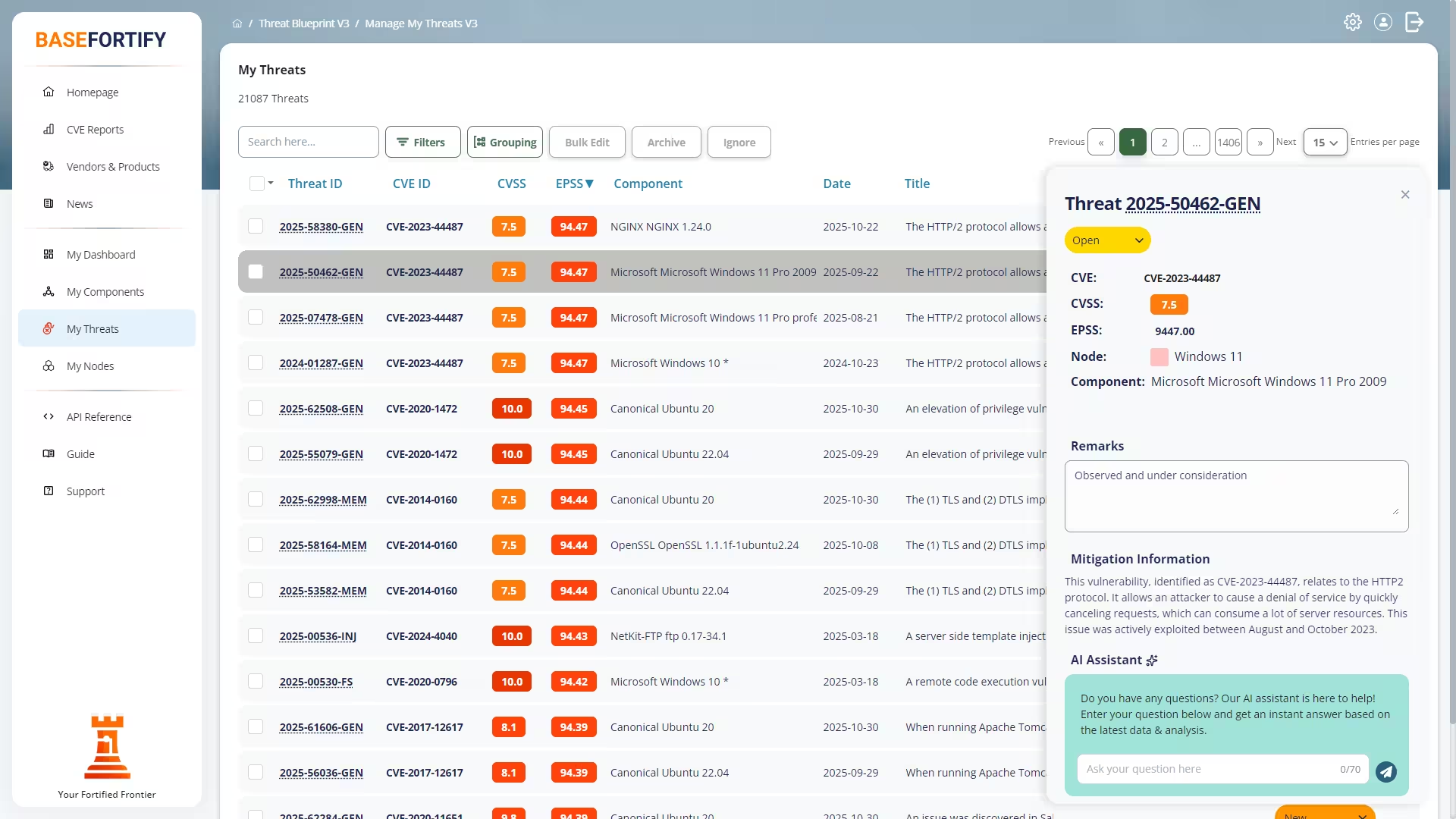
- Threats move through a structured remediation workflow to help teams address issues efficiently and consistently.
Remediation Workflow
- Every threat includes a clear, actionable fix — with the AI assistant ready to explain or refine it on demand.
- Handle multiple related vulnerabilities at once with bulk updates when several CVEs impact the same component.
- View threats grouped by component, giving you an instant overview of which systems need attention first.
Ready to explore how this fits your environment?
Dashboards & Reporting
- View a real-time dashboard with top threats, recent threats, and priority items ranked by CVSS or EPSS.
- See which components are most affected through an automatically generated Top Components list.
- Understand overall exposure with a threat-status histogram showing progress across lifecycle stages.
- Explore each device using an attack-chain diagram that visualizes how multiple CVEs can be linked during exploitation.
- Attack chains are generated using CWE, CAPEC, and MITRE ATT&CK mappings for clear insight into real-world risks.
Single Sign-On
- Integrate seamlessly into your identity landscape with Single Sign-On (SSO) based on SAML.
- Employees authenticate once through your identity provider — no extra passwords to manage.
- Centralised identity control ensures consistent access policies, fast onboarding, and secure offboarding.
Online Support
- Contact our support team directly through integrated in-app chat for assistance while using BaseFortify.
- Submit support tickets for issues requiring further investigation, and track their progress through clear resolution statuses.
- Get help with product features, account management, and questions about using the platform effectively.
Deployment & Installation
- No agents, scanners, or complex infrastructure — setup is fast and lightweight.
- Add components manually, import in bulk, or sync automatically through the REST API.
- New users follow an interactive onboarding track supported by the built-in AI assistant.
Data Protection & Privacy
- All customer data is stored securely in the Netherlands and encrypted in transit and at rest.
- Access is restricted to authorised support staff, with intentionally short retention periods.
- GDPR-aligned handling ensures confidentiality, transparency, and full control over your data.
Compliance & Standards
- Runs within an ISO 27001-certified environment for secure operations.
- Developed using OWASP-aligned practices to reduce exposure to common vulnerabilities.
- Designed with accessibility in mind, following recognised WCAG guidance to support an inclusive user experience.
Integrations
Connect BaseFortify with your existing tools and infrastructure through secure integrations and supported data exchange. From identity management and notifications to REST API automation, BaseFortify helps vulnerability intelligence fit into your existing workflows. Integration capabilities vary by service and subscription, with additional options being developed over time.


Ready to explore how this fits your environment?
Getting started is simple
Three straightforward steps — add your components, see your risks, and start fixing what matters most.
Add your components
Enter components manually, paste command output from your systems, or import lists from CSV or JSON. As soon as they are in, they are matched to official CPEs.
See relevant vulnerabilities
CVEs tied to your stack are surfaced with CVSS, EPSS, and CISA KEV context, so you immediately see which issues are most urgent for your environment.
Act and track progress
Use enriched reports, clear remediation steps, and status tracking on nodes and components to follow work through to completion without spreadsheets.